
Start with the family, not the roster
Before anyone signs up to cook, one person should have a short, quiet conversation with the family, or with whoever is closest to them. Everyone wants to help in the first week. The useful thing is to find out what help is actually wanted, so the family only has to answer these questions once.
- How many people are eating, and how many of them are small children.
- Allergies and dietary needs: coeliac, nut allergy, vegetarian, halal, low salt after a hospital stay, no spice for a nursing mum who has noticed it upsets the baby.
- Likes and dislikes. A family that hates mushrooms will be grateful you asked.
- Which nights. Most families do best with three or four nights a week, not seven. A meal every night can feel like a stream of visitors.
- When to drop off and how. A time window, whether to knock or leave it on the step, and whether there’s an esky by the door.
- How long. Two weeks for a new baby is common. For an illness or a death, plan the first fortnight and check in again before extending.
Write the answers down once and put them where every cook can read them. That one paragraph saves the family dozens of “does Leo still eat pasta?” messages.
How often, and for how long
There’s no single right answer, but some patterns work well for different situations.
| Situation | Nights a week | Typical length |
|---|---|---|
| New baby | 3 (Mon, Wed, Fri) | 2–3 weeks |
| Surgery or a short illness | 3–4 | Until they’re back on their feet, often 2 weeks |
| Long treatment, like chemotherapy | 2, on the harder days after treatment | In blocks of a month, checked each time |
| A death in the family | 4–5 in the first week, then 2–3 | 2–4 weeks, then a gentle check-in |
A roster that runs for a month is easier to keep going than one that tries to cover every night. People who cook once a fortnight tend to keep cooking. People asked to cook every week tend to drift off by week three.
For long illnesses, fewer helpers doing more turns is harder than many helpers doing fewer. If you have eight willing cooks and three nights a week, each person cooks roughly once every two or three weeks, which most people can keep up for months.
Food that helps
The best meal-roster food reheats well, travels well and doesn’t need anyone to cook it further. Good choices:
- Soups, curries, casseroles and stews in containers that don’t need returning.
- A tray bake or baked pasta, with a salad in a separate bag so it doesn’t go soggy.
- Something for breakfast or lunch alongside dinner: muffins, a loaf of bread, a bag of fruit.
- Snacks a parent can eat one-handed at 3 am while feeding a baby.
- For a grieving household with visitors coming through: plates of sandwiches, a cake, milk, tea and coffee.
Label everything with what it is, the date, how to reheat it and any allergens. Use masking tape and a marker. It sounds fussy, but a tired person opening the freezer two weeks later will thank you.
Use disposable containers or ones you genuinely don’t want back. A family dealing with a new baby or a death should never have to work out whose dish is whose.
To stop four cooks bringing lasagne, keep a short running list of what each night’s cook is bringing, in the same place as the roster. A quick glance before you shop is all it takes.
Drop-off etiquette
This is the part people get wrong out of kindness. A meal roster is for food, not for visits, unless the family says otherwise.
- Arrive inside the time window you were given. Early is as unhelpful as late when a baby has just gone down.
- Send a short message when you’re on the way, or as you leave it on the step: “Dinner’s at the door, chicken soup and bread, no reply needed.”
- Don’t expect to come in. If you’re invited, keep it to ten minutes unless they clearly want company.
- Don’t ask for updates on the illness, the birth or the funeral. Let them tell you if they want to.
- Never expect a thank-you card. A family being fed by twenty people cannot write twenty notes.
If you can’t make your night, say so as early as you can and to the organiser, not to the family. The family shouldn’t ever be the one who finds out dinner isn’t coming.
Keeping the roster itself simple
A meal roster needs only a few things written down: the date, the drop-off window, who is cooking, and the family’s notes. You can run it on a printed sheet, a shared spreadsheet or a group message for a fortnight. Past that, a few things start to go wrong: two people take the same night, someone cooks three times while someone else hasn’t had a turn, and nobody is sure which version of the list is current.
A few habits keep it calm:
- One organiser. Not the family. One friend who knows everyone and is happy to get the messages.
- Plan two weeks at a time, so cooks can shop ahead and the roster can change gently.
- Ask helpers which days they’re away, and work around them, rather than asking each person to pick nights. Picking nights tends to fill Mondays twice and leave Fridays empty.
- Keep a reserve list of two or three people who are happy to cover at short notice.
- Share one link, not a photo of a list. A photo goes stale the first time a night changes.
If you want to print something, the meal roster template has columns for the date, drop-off time, cook and what they’re bringing.
Running a meal roster in FairTurns
FairTurns is a free roster app that suits a meal train well. You make a team called something like “Dinners for the Okafors”, click Monday on the calendar, set the drop-off window (5:00–5:30, say) and choose Every week on Monday. Do the same for Wednesday and Friday, and the dates are kept ahead for you (3, 6, 9 or 12 months, as you choose).
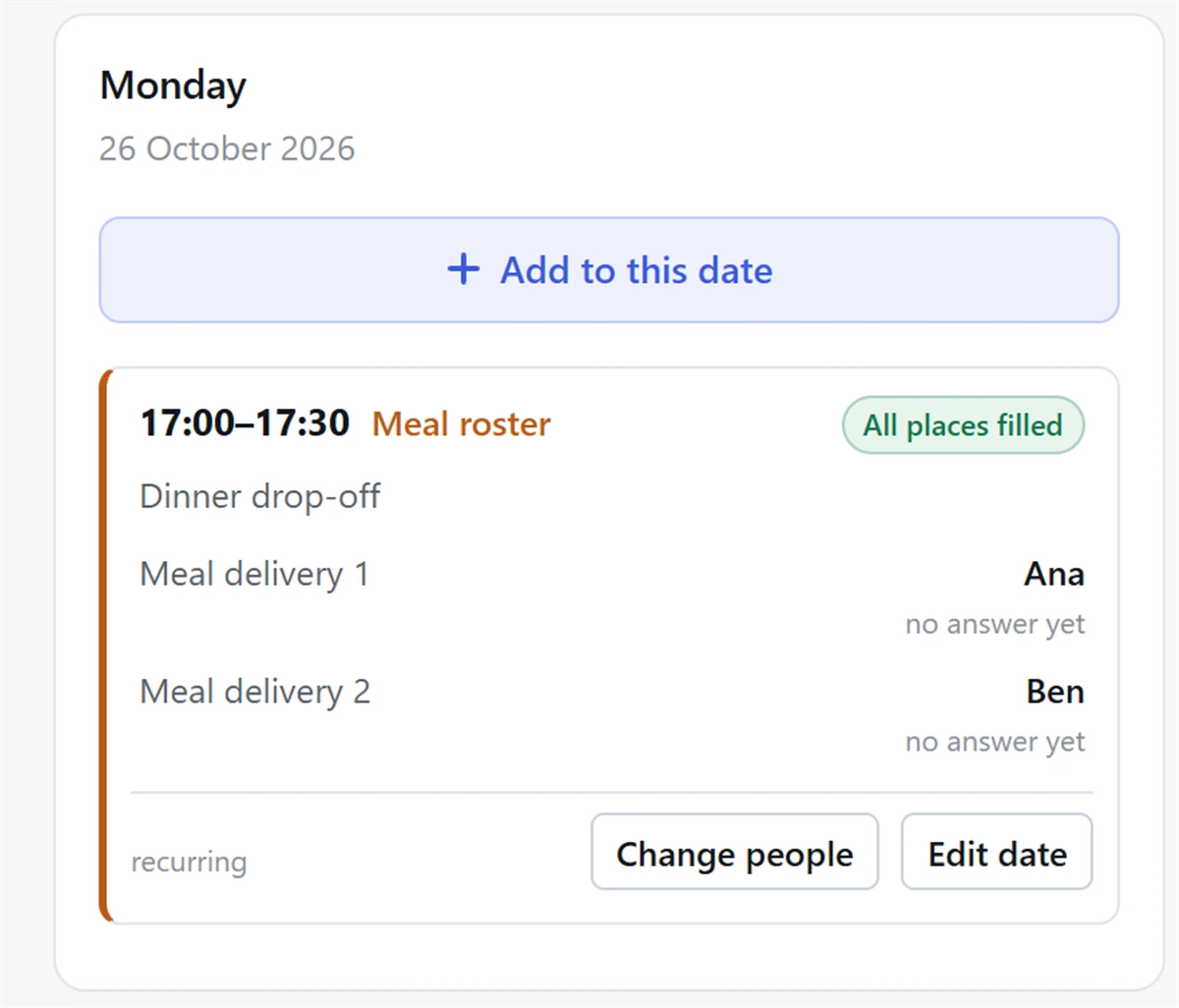
Add the cooks by email, or by name only for anyone who doesn’t want an account. Then press Fill: each night goes to whoever has had the fewest turns so far, so the cooking is shared out without you counting. Helpers mark the days they’re away, and Fill leaves them off those nights.
Turn on the public roster link and send it to everyone, including the family if they’d like to see who is coming. It shows names and dates only, no email addresses, and nobody needs to sign in. When the meal roster ends, you can cancel the remaining dates in a minute.
With Pro, cooks get a reminder before their night, and anyone who can’t make it can say so from the email; with filling by itself switched on, the next person in line is put on and asked. More on this sort of roster on the meal roster page.
Questions
How many people do I need for a meal train?
For three nights a week over a month, eight to twelve cooks is comfortable. Each person cooks once every two to four weeks, which is easy to keep up and leaves room for people who are away.
Should the family see the roster?
Ask them. Some families like knowing who is coming each night, others would rather just open the door to dinner. A read-only link works either way, and the organiser can keep the family notes up to date.
What if someone wants to drop off a meal on a night that isn’t theirs?
Suggest a freezer meal instead. Two dinners on the same night means one goes in the bin, while a labelled freezer meal can fill a gap later.
How do I end a meal roster kindly?
Agree an end date with the family at the start, then check in a few days before it. Many families are ready to stop, and some will be glad of one more week of a couple of nights.