
The definition
A duty roster is a schedule that assigns people to duties over a period of time. Each line answers three questions: what the duty is, when it happens, and who is on it.
The word “duty” is the key. A duty is a responsibility that has to be covered whether or not anyone feels like it: locking up, supervising the playground, answering the after-hours phone, washing the cups. A duty roster makes sure someone is always on, and that the same person isn’t always the one.
In Australia and New Zealand people mostly say roster. In the UK it’s often a duty rota, and in the US a duty schedule. They mean the same thing. There’s more on the words in roster vs rota vs schedule.
Everyday examples
Duty rosters turn up wherever a shared job needs covering. A few you might recognise:
School yard duty
Which teachers supervise the oval, playground and front gate at recess, lunch and before school.
Club duties
Who opens the clubhouse, runs the canteen, does the BBQ or keeps score each Saturday.
Office kitchen
Who empties the dishwasher, wipes the benches and takes the recycling out each week.
On-call
Which manager or technician answers the phone after hours each week.
Share house
Whose week it is for the bins, the bathroom and the vacuuming.
Community groups
Who opens the hall, counts the float or drives the van each week.
Hospitals, ships and the military use duty rosters too, often with long shift patterns and strict rules about rest. Those are specialised. Most duty rosters are much simpler: a handful of duties, a group of people, and a repeating week.
A simple duty roster format
Whatever the setting, a clear duty roster has the same parts:
- A title and period: “Office kitchen duty roster, Term 1” or “October–December”.
- Dates down the side, with the day of the week. “Mon 3 Nov” is easier to read than “3/11”.
- Duties across the top, one column each, with the time if it matters.
- One name per box, or two where the duty needs two people.
- The rules at the top or bottom: how to arrange a change, who to tell, what the duty involves.
Here is what that looks like for a small office kitchen:
| Week starting | Dishwasher | Benches and fridge | Recycling (Thu) |
|---|---|---|---|
| Mon 3 November | Aisha | Liam | Dev |
| Mon 10 November | Mei | Olu | Aisha |
| Mon 17 November | Liam | Dev | Mei |
| Mon 24 November | Olu | Aisha | Liam |
Notice that each person moves to a different duty each week, so nobody is stuck with recycling. That is the simplest form of a rotation: people move through the duties in turn. The rotating roster guide covers rotation patterns in more detail.
What makes a duty roster work
The format is easy. Keeping it working for months is the hard part. Things that help:
- Make it visible. A duty roster nobody can find doesn’t get followed. Pin it where the work happens, or share it on a link everyone can open on their phone.
- Plan far enough ahead. Four to twelve weeks gives people time to see clashes and arrange changes.
- Ask who’s away before you write it, not after. Leave, holidays and regular commitments are easier to work around up front.
- Count the turns. Over a term, look at who has done how many duties. It is the quickest way to spot that one person has done twice as many as another.
- Have one rule for changes. For example: “Arrange cover yourself, then tell the office manager.” One version of the roster, one person who updates it.
- Keep the duty description short. If a duty needs a checklist, put it on the wall where the duty is done.
A paper duty roster works well for a small, stable group. Once people start changing dates, or there are several duties across several teams, keeping one up-to-date version gets harder. The printable vs online roster guide covers when to switch.
Making a duty roster in FairTurns
FairTurns is a free roster app built around this kind of list. You make a team for the duties (say, “Office kitchen”) and give it positions: Dishwasher, Benches, Recycling. Click a Monday on the calendar, choose Every week on Monday, and the dates are kept up to 12 months ahead.
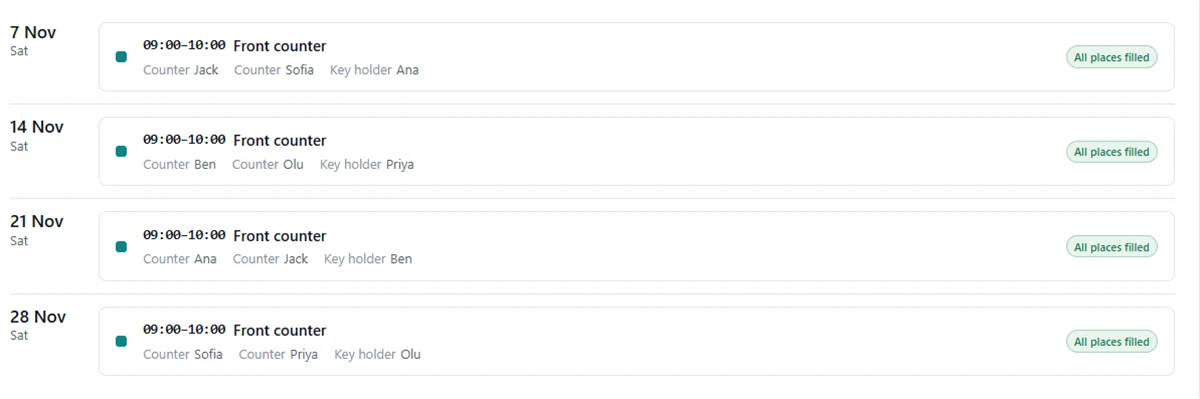
Add your people, then press Fill: each empty place goes to whoever has had the fewest turns in that position, so people move through the duties without you working out the rotation. People mark the days they’re away and Fill leaves them off. Turns booked shows how many duties each person has, and everyone sees the roster on one link. See the duty roster page, or start from a printable duty roster template.
Questions
What is the meaning of duty roster?
A duty roster is a schedule showing which person is responsible for which duty on which date. It shares out regular jobs, like supervision, cleaning or on-call, so they are always covered.
What is the difference between a duty roster and a work roster?
A work roster usually sets people’s working hours or shifts. A duty roster shares out particular jobs on top of normal work, like yard duty for teachers or kitchen duty in an office.
Is a duty roster the same as a rota?
Yes. Rota is the usual British word and roster the usual Australian one. Both mean a list of who does what, and when.
How do I make a duty roster fair?
Share the duties out by counting turns, rotate the days and the duties so nobody is stuck with the worst one, and publish it so everyone can see how it has been shared.