The short answer
A roster, a rota and a schedule can all describe the same sheet: dates down the side, names against each one. An Australian nurse checks the roster, a British flatmate checks the cleaning rota, and an American barista checks the schedule. They are looking at the same kind of thing.
The differences are in country and in shades of meaning. Roster leans towards a list of people taking turns at duties. Rota leans towards the rotation itself, the order in which turns come round. Schedule is the broadest word: it can mean any plan of times, including a bus timetable or a project plan with no names on it at all.
Which word is used where
| Where | Usual word for who’s on | Notes |
|---|---|---|
| Australia | Roster | “Rostered on”, “rostered off”, a rostered day off (RDO), the canteen roster, the bin roster |
| New Zealand | Roster | Much as in Australia; “rota” turns up too |
| United Kingdom | Rota | Cleaning rota, staff rota, the school run rota; “roster” is used in some workplaces |
| Ireland | Rota or roster | Both are common, often depending on the workplace |
| United States | Schedule | “Who’s on the schedule this week?” A roster usually means a list of team members |
| Canada | Schedule | Close to US use, with “roster” for a team list |
So a UK reader searching for a chore rota and an Australian searching for a chore roster want exactly the same thing. If you write for a mixed group, it does no harm to use both words once, as in “the roster (or rota)”.
Where the words come from
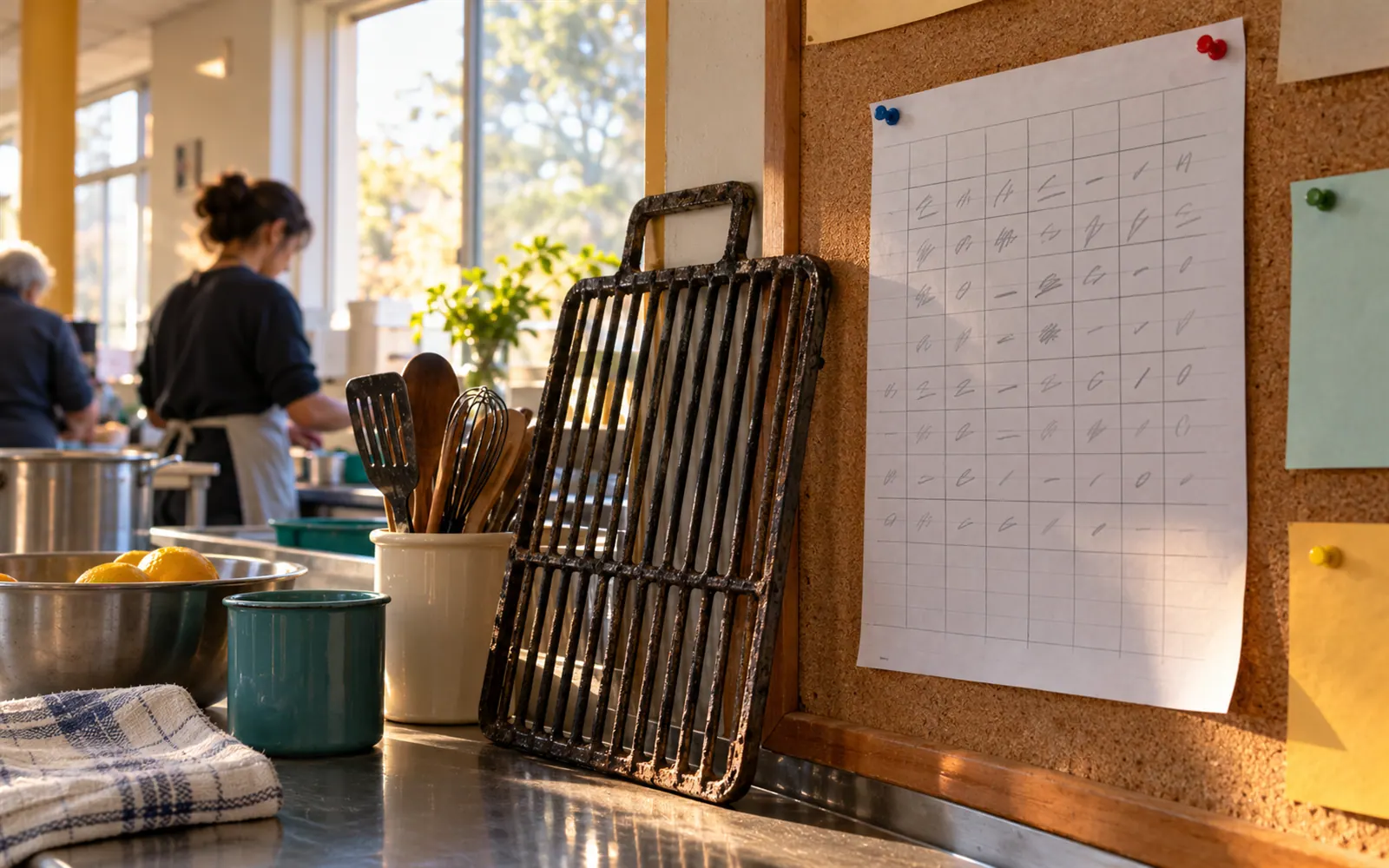
Roster came into English from the Dutch word *rooster*, which meant a gridiron or grate. The usual explanation is that a list ruled up into rows and columns looked like the bars of a grate, and the word passed from the grid to the list on it. It was a military word in English first, for the list of soldiers and their duties, before it spread to every other kind of duty list.
Rota is the Latin word for a wheel. That is a good picture of what a rota does: the turns go round, and when the last person has had a go, it comes back to the first.
Schedule comes, by way of French, from a Latin word for a small sheet of paper. It has always meant a written list or plan, which is why it covers so much more ground than the other two.
Small differences that matter in practice
A roster in the US is often a team list
In American English, a team roster or a class roster is usually the list of members, with no dates at all. If you send a US volunteer a “roster”, they may expect a list of names and phone numbers rather than who is on this Saturday. “Schedule” is the clearer word there.
A rota implies taking turns
Because of the wheel, “rota” suggests a fixed order that repeats: Aisha, then Liam, then Mei, then back to Aisha. That suits a cleaning rota in a flat of four. For a club with forty families and a few people away each week, a strict wheel breaks down quickly, which is one reason to fill by who has had the fewest turns rather than by a fixed order. The fair roster guide shows how.
A duty roster is about responsibility
A “duty roster” names who is responsible for something at a given time: the duty manager, yard duty, the first-aid officer on site. It is common in schools, the services and workplaces. More on that in duty roster meaning.
Rostered on, rostered off
Australians use roster as a verb all the time. You are rostered on for Saturday, rostered off over Easter, or rostered with someone you like. In the UK you are more likely to be “on the rota”, and in the US “scheduled”.
Roster vs roaster
A roaster is something that roasts: a coffee roaster, a roasting tin, or a chicken sold for roasting. It is easy to type by accident, especially on a phone, and spell-checkers let it through because it is a real word.
If you’ve been searching for a roaster template and getting pictures of ovens, you probably meant a roster template. One quick way to remember it: a roaster has a roast in it, and a roster has people on it.
Which word should you use?
Use the word your people already use. If your club has always called it the canteen roster, keep calling it that. A new word on the top of the sheet makes people wonder whether something else has changed.
- Writing for Australians or New Zealanders: roster.
- Writing for people in the UK: rota, with “roster” where a workplace already uses it.
- Writing for Americans or Canadians: schedule for who’s on when, roster for a list of members.
- Writing for a mixed group online: pick one and mention the other once.
Whatever you call it, the things that make it work are the same: it’s made early, the turns are counted, and everyone can see it.
Making one, whatever you call it
If you want to make one now, the free roster maker and the UK rota maker both build a list of who is on each date from names you type, ready to print or download. The rota template is a blank to print.
FairTurns uses the word roster, but it works the same for a rota or a schedule: you add the dates, add the people, and it shares the turns out and puts the result on one link anyone can open.
Questions
Is a rota the same as a roster?
Yes, in everyday use. Rota is the usual British word and roster the usual Australian one. Both mean a list of who is on duty and when.
What does roster mean in the US?
In American English a roster is often a list of the members of a team or class. For who is working when, Americans usually say schedule.
Is it roster or roaster?
For a list of who is on, it is roster. A roaster is something that roasts, such as a coffee roaster or a roasting tin.
What is a rostered day off?
In Australia, a rostered day off or RDO is a day off built into a work roster, often in return for working slightly longer hours on other days. The details depend on the workplace agreement.
Where does the word rota come from?
Rota is the Latin word for wheel, which fits a list where the turns come round in order and start again at the top.