
Two meanings of “rotating roster”
When people search for a rotating roster, they usually want one of two things.
People rotate through turns
The dates stay the same (every Saturday, the first Monday of the month), and different people take them in turn. Bins, canteen, yard duty, on-call, cleaning.
Shifts rotate through people
Each person works a repeating cycle of days and nights, like four days on and four days off. Common in hospitals, mines, emergency services and factories running around the clock.
This guide covers the first kind in detail, since it’s what most clubs, schools, households and small workplaces need, and explains the second so you know where it differs.
Rotation patterns for regular dates
Every rotating roster is built from two parts: when the dates fall, and who is on each one. The “when” is usually one of a few patterns:
| Pattern | Example | Good for |
|---|---|---|
| Every week | Every Saturday, 8:00–10:30 | Canteen, sport, bins, Sunday morning teams |
| Every second week | Every second Thursday | Fortnightly cleaning, on-call by fortnight, alternating weekends |
| The same weekday each month | Every first Monday, every fourth Saturday | Committee meetings, a monthly working bee, a monthly market |
| The last weekday of the month | Every last Friday | Stocktake, a monthly social night |
| A date of the month | Every 25th | Paying the bills, a monthly check |
| Just once | Saturday 14 March | A fete, a working bee, Christmas Eve |
A roster can mix these. A sports club might have canteen every Saturday, a committee meeting every first Monday, and a working bee just once in autumn.
Ways to rotate the people
Once the dates are set, there are a few common ways to move people through them.
Straight rotation (round robin)
A, B, C, D, then back to A. Simple, predictable and easy to print. It works well when everyone is always around and every date is the same. It breaks down the moment someone is away: either the order shifts and everyone has to recheck, or the away person’s turn is skipped and they fall behind.
Fewest turns first
Each date goes to whoever has had the fewest turns so far, skipping anyone who is away. When two people are level, the one who has waited longest goes first. This gives the feel of a rotation but copes with absences and newcomers: someone who joins halfway through isn’t handed every date until they “catch up”, and someone back from holidays simply picks up again.
Rotating jobs
Where each date has several jobs (dishes, benches, recycling), people move to a different job each time as well as taking turns. Count turns per job, not just in total, so nobody does recycling every time they’re on.
Rotating days
If the same job happens on several days, rotate the day too. A teacher who always gets Monday yard duty misses out on every public holiday Monday, and another always gets Friday.
Shift cycles: 4 on 4 off and others
The other kind of rotating roster gives each person a repeating cycle of shifts. Some well-known examples:
- 4 on, 4 off: four days (or nights) of work, then four days off, an eight-day cycle.
- 2-2-3 (Panama): two on, two off, three on, then the reverse, over a fortnight.
- Days to nights: a block of day shifts, then rest, then a block of night shifts.
- Fly-in fly-out swings: for example two weeks on site, one week home.
Because these cycles don’t line up with the seven-day week, the days people work drift from week to week. They are usually built in specialist workforce software that also handles hours, fatigue rules, award rates and pay. If that’s what you need, you need that kind of tool.
In FairTurns, dates repeat weekly, every second week, monthly (an nth or last weekday, or a date of the month) or just once. It doesn’t repeat 4-on-4-off or other cycles that aren’t tied to the week. For those, use workforce scheduling software.
Setting up a rotating roster in FairTurns
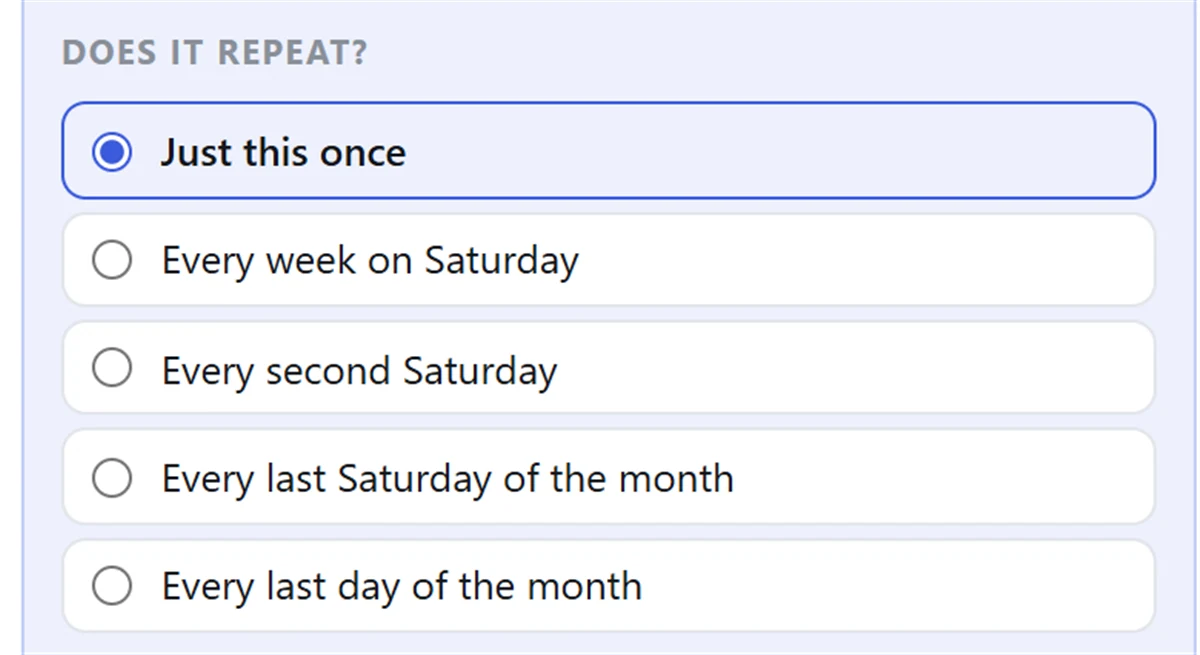
For rotations of people through regular dates, FairTurns is free and does the counting for you. Click the day the roster starts, set the time, and choose from sentences built from that day: Every week on Saturday, Every second Saturday, Every fourth Saturday of the month, Every last Saturday of the month or Every 25th of the month. The dates are kept 3, 6, 9 or 12 months ahead, and new ones appear as old ones pass.
Add the people, then press Fill. Each empty place goes to whoever has had the fewest turns in that position, and away people are left off. Named positions give you rotating jobs, with turns counted per position. If you change one date, only that one changes. When the team changes, Redistribute shares the future dates out again.
To try a rotation without signing up, the free fair rotation generator makes one you can print or download. There’s also a fortnightly roster template, and more about the calendar in repeating dates.
Questions
What is a rotating roster?
A roster where people take turns through the same regular dates or jobs, so the turns move around the group rather than one person always doing the same day or job.
How do I make a rotating roster fair when people are away?
Instead of a fixed order, give each date to whoever has had the fewest turns and isn’t away. People who miss a turn pick up again without the whole order shifting.
What is a fortnightly rotating roster?
A roster where the dates repeat every second week, such as every second Saturday, and people take those dates in turn. It suits jobs that don’t need doing weekly.
Can FairTurns do a 4 on 4 off roster?
No. FairTurns repeats dates by the week and the month, which suits turn-taking rosters. Eight-day shift cycles need workforce scheduling software.