
Why pairing belongs on the roster
Most workplaces and volunteer groups agree that new people should learn alongside someone experienced. Then the roster goes out, and the new person is on Tuesday with another new person, because that’s how the turns fell.
If pairing only lives in the manager’s head, it gets lost the first busy week. Put it on the roster itself, so every date has someone who knows the job and the trainee is always next to them.
This works the same whether it’s a clinic front desk, a café, a surf club patrol, a sound desk or the cash register at an op shop.
Set up two kinds of place
The simplest way to build pairing in, and the easiest to explain, is to split each turn into two named places:
Lead
Someone signed off to run the turn on their own. Only experienced people are put here.
Second
Anyone else, including trainees. Experienced people can be here too when there are no trainees.
Now every date has one lead and one second. A trainee can never end up in charge, and two trainees can never be on alone together, because there is only one second place.
If a turn needs three people, add a second Second place. Keep the number of trainees on any one date to what one lead can actually look after. For most jobs that’s one, occasionally two.
How often should a trainee be on?
This is where rostering trainees differs from rostering everyone else. Skills fade between turns. Someone who does their first three turns a month apart starts nearly fresh each time.
- Early on, cluster the turns. Several turns over the first two or three weeks builds confidence faster than the same number spread over three months.
- Vary the leads. Working with two or three different experienced people shows the trainee that there’s more than one right way, and it shares the teaching load.
- Vary the days, if the work differs. The Monday rush and the quiet Thursday teach different things.
- Then settle to the normal pattern once they’re comfortable, so they’re not doing more than everyone else for months.
Mentors need looking after too. Being the lead with a trainee is more tiring than working alongside a peer. If the same experienced person is always paired with new people, they’ll tire of it. Share the lead turns between all your experienced people, and give each of them some turns without a trainee.
Stages before going solo
Write down what “ready” means, so it’s not left to a feeling. A three-stage approach suits most jobs:
- 01
Watching
The trainee is on as an extra, watching and helping. The turn is fully covered without them.
- 02
Doing, with backup
The trainee does the job in the Second place, with the lead stepping in when needed.
- 03
Signed off
The lead or a supervisor agrees they’re ready. They can now be put in the Lead place.
A simple checklist for each stage helps: opening up, closing down, handling a complaint, what to do in an emergency. Keep it wherever the work happens, not on the roster.
When someone is signed off, change it on the roster straight away. People who are ready but never get a lead turn lose confidence, and the experienced group stays smaller than it needs to be.
Setting it up in FairTurns
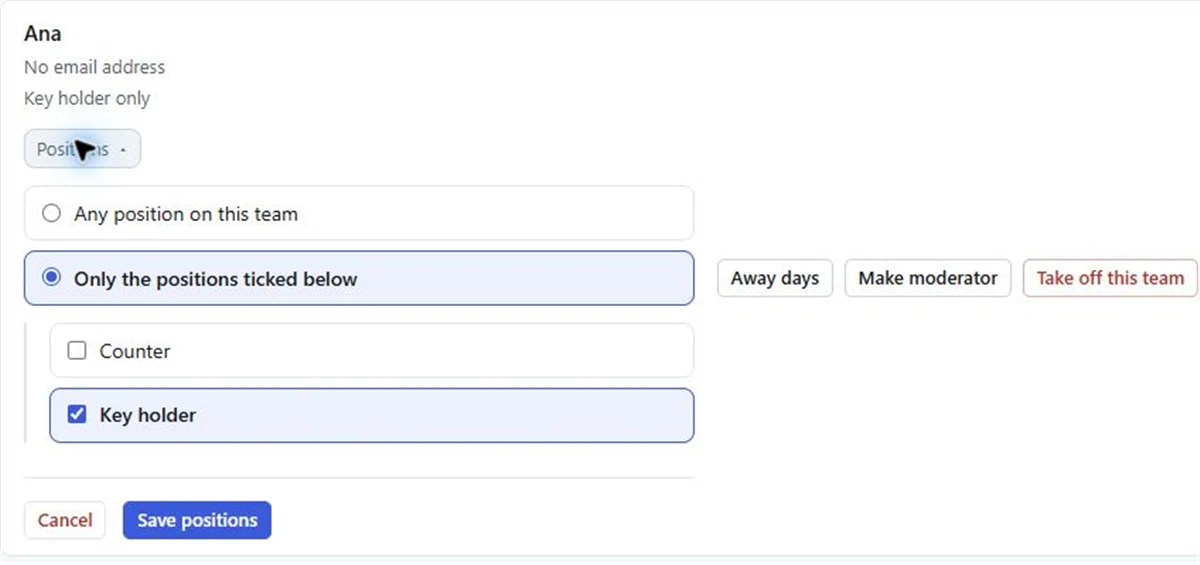
FairTurns is a free roster app that handles this with positions. Give the team two positions, Lead and Second, each with a headcount of one. Then set each trainee to Only the positions ticked below, with just Second ticked, so only your experienced people can be in Lead. Nobody is put on a position they aren’t set up for, so a trainee is never rostered as lead.
Press Fill and each empty place goes to whoever has had the fewest turns in that position. Leads are shared out among experienced people, seconds among everyone else, and Turns booked shows the count. When a trainee is signed off, add Lead to the positions they can do, and the next Fill starts using them there.
With Pro, How often lets you set each person to More often, Normal, Less often or Now and then, position by position. A new person can be on More often in Second for their first couple of months, then back to Normal. A senior person who would rather teach less can be Less often in Lead. Read more in How often and positions and headcounts.
Questions
How do I make sure a trainee is never rostered alone?
Split each turn into a Lead place and a Second place, and only allow experienced people in Lead. Every date then has someone experienced, and there’s only room for one trainee beside them.
How long should someone be a trainee?
It depends on the job. Define what being ready looks like in a short checklist, and sign people off when they meet it rather than after a fixed number of weeks.
Should trainees be rostered more often?
Clustering a new person’s first few turns close together helps them learn faster. After that, a normal pattern is fine.
How do I stop my experienced people burning out?
Share the lead turns between all of them, give each some turns without a trainee, and sign new people off promptly so the experienced group grows.