
What “fair” means for a roster
Ask ten people what makes a roster fair and you get ten answers. The parent with three kids in the club thinks it should be by family. The person who does the 6 am opening thinks early starts should count double. The new member wonders why they have been on four Saturdays running.
Most arguments about rosters are not really about the number of turns. They come from three things: people finding out late, people suspecting that someone else is getting off lightly, and changes that happen in private messages. So a practical definition of fair has three parts:
- It’s visible. Everyone can see the whole roster, not just their own dates, well before the first date.
- It’s counted. Turns are handed out by a count anyone could check, not by memory or by who answers their phone.
- It’s open to change. People can say when they can’t do a day before you write the roster, and swaps and changes show up where everyone looks.
Fair doesn’t have to mean identical. A trainee might do fewer turns at first, and the person who also runs the committee might do fewer still. That is fine, as long as the reason is known and the roster itself is out in the open.
Step 1: Write down the jobs and how many people each needs
Start with the work, not the people. List each job that has to be covered and how many people it needs every time. For a swim club that might be two marshals, two timekeepers and two in the canteen on a Saturday morning, and two in the canteen on a Wednesday night.
Split jobs that need different skills. “Canteen” and “canteen, money and float” are different jobs if only some people know how to cash up. Splitting them now saves you from rostering three people who have never touched the till.
Then check the headcount honestly. If the canteen has always had three on but two is enough, cut it to two. Every extra place on every date is another turn somebody has to do across the year.
Step 2: List the people, and who can do what
Write down everyone who should take a turn. Then mark, next to each name, which jobs they can do. Most people can do most jobs; the point is to catch the exceptions. Someone without a working-with-children check can’t do the junior session. A teenager can run the scoreboard but not the barbecue.
Decide how you count a household. For a club where families take turns, one name per family usually works better than one per person. For a workplace or a flat, it’s one per person.
Finally, note anyone who should be on less often and why: a new volunteer who is still learning, a committee member, someone who has asked for a lighter load this season. Keep that list short and known.
Step 3: Set the pattern of dates
Write out the dates for the period you’re rostering. A school term or the next three months is a good length: long enough that people can plan, short enough that it stays accurate. Most groups go wrong by rostering a whole year in January and then rewriting it every month.
Use the real pattern. “Every Saturday in season”, “every second Tuesday”, “the last Sunday of the month”. Cross off the dates you already know are off: public holidays, school holidays, the club’s bye rounds. If a date has two times, such as a morning and an evening, decide whether the same person covers both or they count as two turns.
Step 4: Collect away days before you start
Before you put a single name down, ask everyone which dates they can’t do. A short message is enough: “Rostering March to May this week. Send me any dates you’re away by Friday.” You will save yourself a round of swaps later.
Only ask for the days people can’t do. If you ask which days people prefer, everybody picks the same easy ones and you end up doing the hard ones yourself. And treat an away day as a fact, not something to justify: you don’t need to know why.
Step 5: Share the turns out by counting
Now fill the places in date order. For each empty place, pick the person who can do that job, isn’t away that day, isn’t already on somewhere else at the same time, and has had the fewest turns so far. When two people are level, pick the one who has waited longest since their last turn.
Keep a tally as you go. It takes a few minutes on paper and it stops the most common unfairness: the reliable person getting a second turn before someone else has had their first.
| Saturday | Marshal 1 | Marshal 2 | Why |
|---|---|---|---|
| 1 March | Aisha | Tomás | Everyone on 0, top of the list first |
| 8 March | Mei | Hamish | Next two on 0 |
| 15 March | Kofi | Priya | Tomás is away, so Priya moves up |
| 22 March | Tomás | Aisha | Tomás has waited longest of those on 1 |
Two more checks before you publish. Look for the same two people paired together every week and mix them up a little, because people enjoy a change and it spreads know-how around. And look at the hard dates (the grand final, the Christmas week, the 6 am starts) to make sure they haven’t all landed on the same few names.
If counting by hand sounds like a chore, the free roster maker does exactly this from a list of names and dates, and the fair rotation generator does it for simple “whose turn is it” lists.
Step 6: Publish it early, in one place
A fair roster that nobody sees until Thursday isn’t fair to the person who already booked a weekend away. Publish it at least two weeks before the first date, and longer for anything that needs childcare or travel.
Put it in one place everyone can find. A sheet on the fridge works for a household. For a club or a team, a single link people can open on their phone is better than a PDF in a group chat, because there is only ever one version. Show everyone’s dates, not just each person’s own: seeing that the load is shared is half of what makes it feel fair. For a printable starting point, use the roster template.
Keeping it fair when things change
The roster you publish is the easy part. Fairness gets lost in the weeks after, one change at a time.
- When someone can’t make it, ask the person who has had the fewest turns, not the one who always says yes. There’s more on this in what to do when someone can’t make it.
- When someone swaps, update the roster everyone looks at, the same day.
- When someone joins, give them a few turns soon rather than putting them at the back of the queue, so they learn the job while they’re keen.
- When someone leaves, hand out their dates to those with the fewest turns, and change as few other dates as you can. Moving everyone’s dates around to tidy up causes more trouble than it solves.
- At the end of each term, look at the count of turns per person. If it has drifted, start the next roster with the people who did less.
Keep the tally from one roster to the next. Starting every term from zero quietly rewards people who joined late or dropped out early.
Doing it in FairTurns
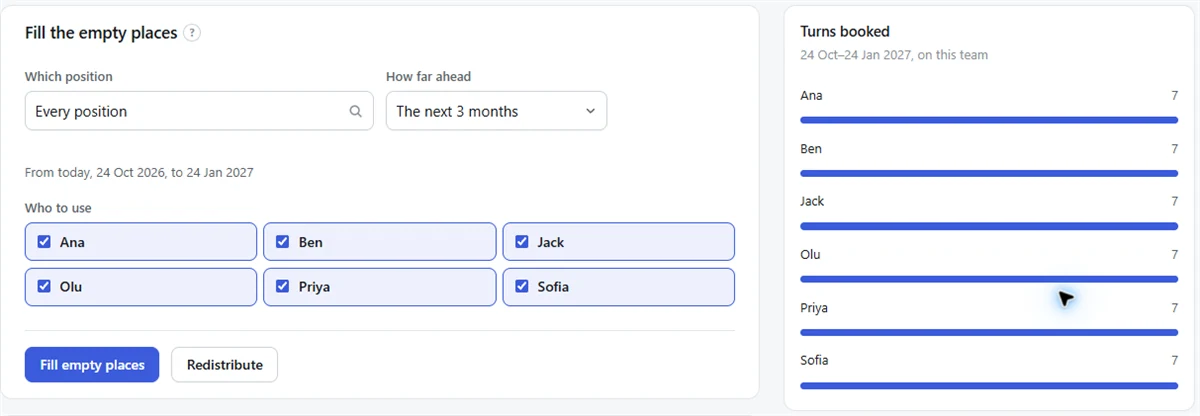
FairTurns is a free web app built around these steps. You click a day to add a date and choose how it repeats, and the dates are kept up to 12 months ahead. Teams can have positions with headcounts, and people can be limited to the jobs they’re set up for. People mark their own away days. Fill then gives each empty place to whoever has had the fewest turns in that position, leaving away people off, and a chart shows how many dates each person has.
When the team changes, Redistribute hands out a leaver’s dates and shows every person who gains or loses a date before anything changes. A public roster link shows the roster to anyone you send it to, without signing in. Everything above is free; Pro adds emails, replies and a How often setting for people who should be on more or less.
Questions
What is the fairest way to make a roster?
Fill each place with the person who has had the fewest turns so far and can do that job, skipping anyone who has said they are away. Publish it early where everyone can see it, and keep the count running from one roster to the next.
How far ahead should a roster be made?
A school term or about three months suits most groups. Publish at least two weeks before the first date so people can plan around it.
Should everyone do the same number of turns?
Not always. Trainees, committee members or people with a lighter load agreed in advance may do fewer. What matters is that the reason is known and the roster is open for everyone to see.
How do I stop the same people doing everything?
Count turns instead of asking for volunteers each week, and when you need cover, ask the person with the fewest turns first rather than the person most likely to say yes.
Is a rota the same as a roster?
Yes. Roster is the usual word in Australia and New Zealand, rota in the UK, and schedule in the US. They all mean a list of who is on and when.